Posted on 6 May 2026 by Jeff Fuge | Reading time 1–2 mins
Imagine a tug of war between two teams. One has three members, the other two. All participants are of equal size and strength. Which team is most likely to win? Or picture a see-saw where five children of equal size and weight are split with three at one end and two at the other. Which way will it tip? If you can answer those simple questions, you’ve already spotted the flaw in 5-star review systems.

The problem with five
Buy some socks online, book a restaurant table or pay a utility bill and you’ll be badgered to leave a review. More often than not, that review will involve a 5-star rating system. Amazon, Trustpilot, Airbnb and eBay all use one.
The prompts, nudges and outright bribes to rate your socks, your meal or your gas payment as five out of five are annoying enough. But the real problem with the 5-star system isn’t the pestering: it’s the number of stars.
With five stars, it’s impossible to say that something simply met expectations — that it was neither terrible nor terrific, just fine — without tilting the balance towards suggesting it was better than that.
Consider the pack of bin liners you ordered: they arrived on time, do the job, and the price was reasonable. If you’re inclined to leave a review, you hover your cursor or finger over the star that best captures “fine and not flawed nor fabulous.” Which do you click? The middle one, naturally. It’s the middle-ground score for a middle-of-the-road product.
But the middle star is the third star. You’re blessing those bin bags with a score of 3/5, which equals 60% not 50%. Was that really your intention?
The 5-star system is a subtle visual trick: clicking the middle option tips the scales away from average and towards good. Sometimes the stars are even labelled with terms such as 1 = terrible, 2 = below average, 3 = average, 4 = above average, 5 = excellent. Whether by accident or by design, this is misleading. Selecting the star labelled ‘average’ delivers a score that is numerically above average.
Accident or design?
It’s a question that deserves more than a passing mention. Platforms that rely on reviews have an obvious commercial interest in scores skewing high. Glowing aggregates attract more customers, more transactions, more revenue. The 5-star system’s built-in upward bias is, to put it gently, rather convenient for the businesses hosting it.
However, the distortion cuts both ways. It isn’t only unfair to reviewers whose wish to convey “it was merely fine” becomes an inadvertent endorsement, but it’s unfair to businesses too. If a genuinely average product or service is systematically scored above average, then a genuinely excellent one is devalued. When scores cluster towards the top, superb products and services fail to stand out and the scale loses its meaning.
The 6-star solution
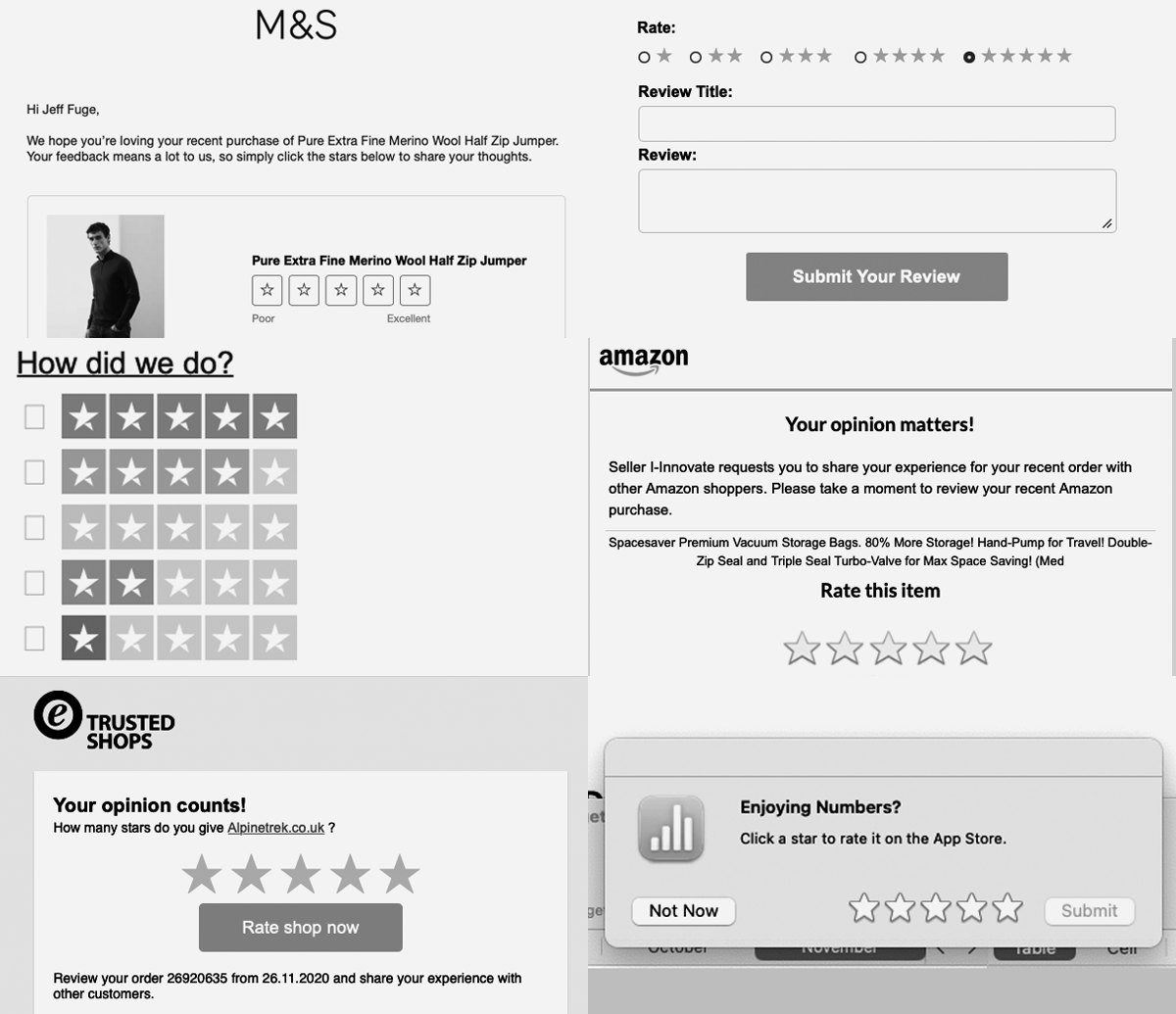
Will you leave us a review? Or should that really say, will you help us sell our stuff?!
The fix is straightforward: add a star. A 6-star system means that selecting three stars delivers an accurate 50% score — a true midpoint that genuinely reflects “meets expectations.”
A 6-star scale may look slightly unfamiliar at first, and there’s a brief cognitive adjustment: the star to the left of centre is now the one to click for a middling experience, rather than the one bang in the middle. But these are minor and temporary inconveniences.
What you gain is fairness — a scale where scores mean what reviewers intend them to mean. And there’s a reputational case for businesses too. Adopting a 6-star system signals that you’re aware of the flaws baked into the standard model and have chosen not to exploit them. In a landscape where trust in online reviews is fragile, that’s worth more than using tricks to try to tip the balance in your favour.