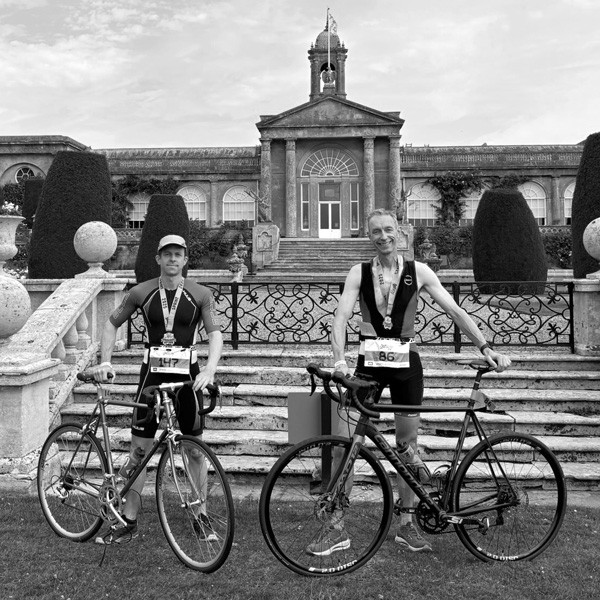
Posted on 28 February 2026 by Jeff Fuge | Reading time 3–4 mins
Recent news of NASA’s plans to head back to the moon reminded me of the story of the space pen. It’s said that during the space race in the 1960s, the Americans spent millions developing a pressurised pen that would work in zero gravity. The Russians simply took pencils.

I’m not an astronaut but I am a triathlete. And if you go to a triathlon you’ll hear plenty of space-pen chatter between competitors in the car park, each discussing their quest for technology-based performance advantage.
“Got these new pedals… they cost me a fortune but are 50g lighter than my old ones.”
“Heard the new carbon frame on the £10K model is more aero… mine’s on order!”
“You got the electronic shifters yet? If you want the benefits of quicker gear shifting, you gotta join the revolution, buddy!”
People go to these expensive lengths which, over the course of an amateur event taking 80 to 100 minutes, may deliver only the smallest and most inconsequential of gains.
And at amateur events like those I attend, gains of a few seconds could be erased or reversed by getting stuck behind a slower swimmer for a length, or having to stop for longer than others at a busy road junction on the bike ride.
All this space-pen thinking got put into context when I took my friend Jon along to take part in his first triathlon last summer.
With little dedicated training, relatively new to freestyle swimming, and riding his eye-brow-raising steel-framed Raleigh racer from the 1990s, he finished an amazing 30th in a field of 180.
(Full disclosure: while now in his 40s, Jon used to race bikes when he was a teenager and is doggedly competitive. In other words, while this was his first triathlon, it was not his first rodeo.)
But here’s the interesting bit: in the swim he finished 70th, then 40th on the bike leg, and 40th on the run. So, how did he bag 30th overall?
The difference that propelled him up the results table was his transition times: from the swim and out onto the bike, then off the bike, back to the transition area and out onto the run.
In the latter, not only was he faster than every other competitor, but up to one minute faster than some who finished in the top 10.
That’s not what you get by buying a £10K triathlon bike: that’s what you get by thinking differently to everyone else.
The simple secret to Jon’s triathlon success
Jon simply thought like the Russians and came up with the triathlon equivalent of pencils. Instead of donning dedicated cycling shoes for the bike ride and then swapping them for running shoes, he wore trainers for the whole shebang.
With 100 metres of grass separating the transition area from the line where you were allowed to get on your bike, Jon was able to quickly and comfortably run where others tottered in their solid-soled cycling shoes.
On the bike, his trainers were held in place with old-school clips and straps. At the end of the bike leg, he could sprint down the grassy field, overtaking those merely able to canter in their cycling shoes and those cautiously running barefoot (with their cycling shoes left attached to their pedals).
Next, while others fiddled and faffed getting cycling shoes off or trainers on (or both) Jon was able to swiftly rack his bike and sprint straight off on the run.
The minute or so of savings with this technique more than offset the seconds he might have gained by wearing dedicated cycling shoes on the bike ride.
His approach is clearly not rocket science, so why did no one else use this method?
Largely because everyone is on a space-pen conveyor belt, indoctrinated by the lure of lighter, newer and more expensive ways to achieve marginal gains – and by the cultural imperative that says if you’re part of the triathlon tribe, this is what we do.
But following the herd shuts us off to the powerful possibilities of pencil-like thinking.
In his book ‘Alchemy: the surprising power of ideas that don’t make sense’, Rory Sutherland outlines the space-pen that is the HS2 rail line and suggests a pencil-like alternative.
HS2 is a £60bn project that could shave roughly an hour off the London-to-Manchester train journey. But, as Rory points out, the scheme’s architects are only thinking about time on the train, while travellers think about the whole journey. And a significant chunk of that is spent waiting at the station.
Thanks to fixed ticketing, passengers routinely arrive up to an hour early to guarantee their seat, sometimes watching earlier trains depart with empty carriages. Rory’s inspired solution is to change the ticketing restrictions and, for an additional fee, allow passengers to hop on an earlier train if space is available.
This could be implemented within six months for about £250K, save travellers up to 40 minutes and free-up capacity on busier trains. It’s a win-win for a pencil-like pittance.
So, here’s to avoiding one-track thinking, and instead to being more like Rory, Triathlon Jon and – dare I say – the Russians.
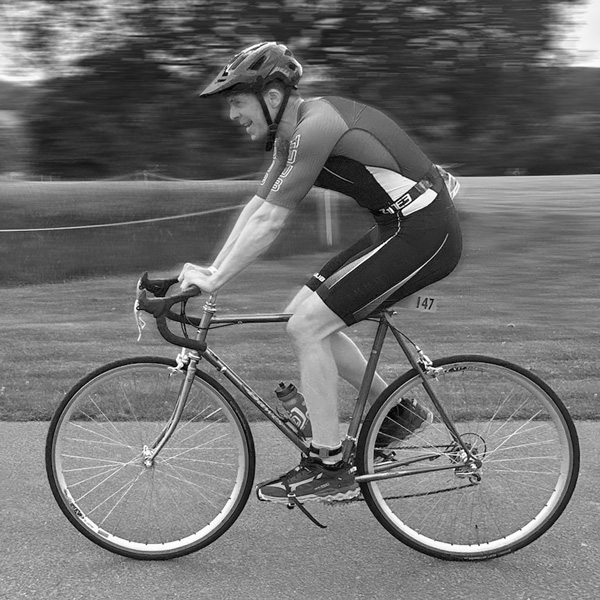
‘None of the gear but a great idea’. It’s Jon flying around the course with trainers, toe-clips and his 1990s Raleigh racer.